
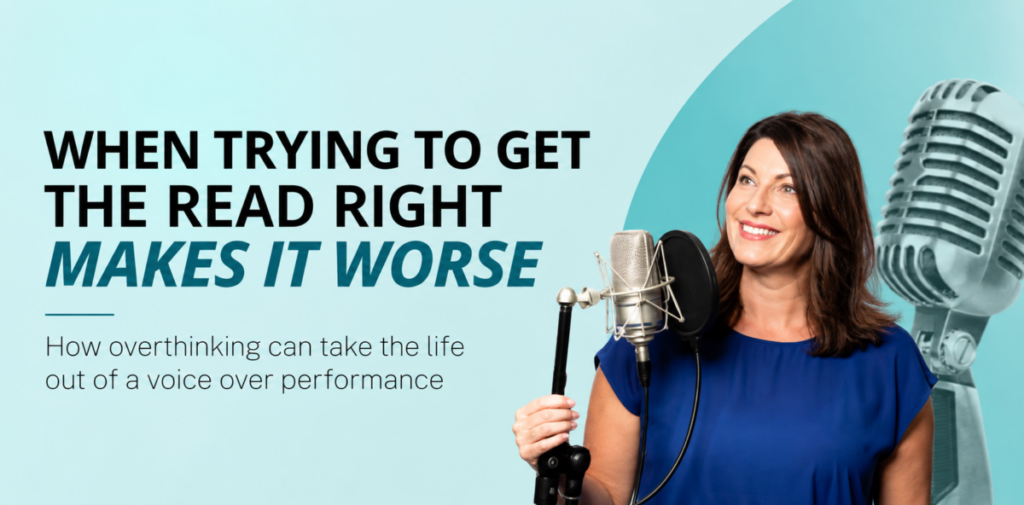
There’s a point in a voice over session where trying harder stops helping.
You start again. Then again. You change a word, adjust the pacing, question the emphasis, listen back, decide you don’t like it and start over.
Before long, you’re so focused on getting the read “right” that you’ve stopped actually communicating anything.
I see this happen with voice actors at every level. And sometimes the answer isn’t another technique. Sometimes you need to stop trying to make the performance perfect.
When Focus Turns Into Overthinking
Being prepared matters. Paying attention to direction matters. Understanding the copy matters.
But there’s a difference between being intentional and trying to control every second of a performance.
When you start monitoring every word while you’re saying it, it becomes difficult to stay connected to what you’re actually communicating. Instead of thinking about the person on the other side of the message, you’re thinking:
Was that enough? Was that too much? Did I hit that word correctly? Should I do it again?
That internal conversation can quickly become louder than the script itself.
A Technically Correct Read Can Still Feel Disconnected
You can pronounce every word correctly. Your timing can be right. Your recording can sound clean.
And the read can still feel like it’s missing something.
Voice over isn’t only about executing words correctly. There still has to be a person behind them. The listener has to believe that you mean what you’re saying.
When all of your attention goes toward avoiding mistakes, it’s easy for that connection to disappear.
Remember Why You’re Doing This
I recently had a coaching session where a student kept restarting a read. She was concentrating so hard on getting everything right that the fun had completely disappeared.
So I asked her a simple question:
Why are you doing this?
Her answer was just as simple:
Because it’s fun.
That was the adjustment. Not another technical note. Not another explanation.
Once she came back to that, the read opened up.
Preparation Should Give You More Freedom
This doesn’t mean technique doesn’t matter. It means technique should eventually give you more freedom to perform.
The work you put into articulation, interpretation, pacing, recording skills and understanding the script gives you tools to pull from when you need them.
Those tools shouldn’t leave you afraid to make a choice.
The goal isn’t to reach a place where every read is perfect. It’s to become prepared enough that you can make a choice, commit to it, listen to direction and adjust when necessary.
That’s a very different kind of confidence.
Stop Fixing Problems That Aren’t There
One of the easiest ways to overwork a read is to assume something must be wrong simply because it didn’t feel perfect.
Before immediately recording another take, ask yourself:
What am I actually trying to change?
If you have a clear answer, make the adjustment.
If you don’t, another take may just be another version of the same read with more tension behind it.
More takes don’t automatically create a better performance. Sometimes they just make you question a perfectly good choice.
Give Yourself Permission to Play
Some of the most interesting performances happen when you leave enough room to discover something.
Try the choice. React to the words. Let something surprise you. You can always adjust afterward.
That willingness to play matters especially while you’re learning. Every read doesn’t need to become a test of whether or not you’re “good enough” at voice over.
Sometimes it’s practice. Sometimes it’s experimentation.
And yes, sometimes it should just be fun.
Confidence Doesn’t Mean Having Every Answer
Confidence in voice over doesn’t mean knowing exactly what to do every single time.
Scripts will change. You’ll get direction. Some auditions will feel strange. Some reads will take more work than others.
The goal is to spend less time asking whether every choice is the “right” one and more time becoming a performer who can make a choice, evaluate it and adapt.
That comes from experience, preparation and having tools you trust.
Don’t Let Perfection Take the Fun Out of Why You Started
Wanting to improve is a good thing. But if every recording becomes another opportunity to criticize yourself, eventually the thing you wanted to get better at stops being enjoyable.
Do the preparation. Learn the craft. Build your skills.
Then give yourself enough room to actually use them.
Sometimes the read doesn’t need another ten takes.
Sometimes you just need to remember:
You’re allowed to have fun doing this.
Want Another Set of Ears on Your Reads?
If you’re working through auditions, performance choices, or trying to understand what’s actually holding a read back, we can work through it together.