
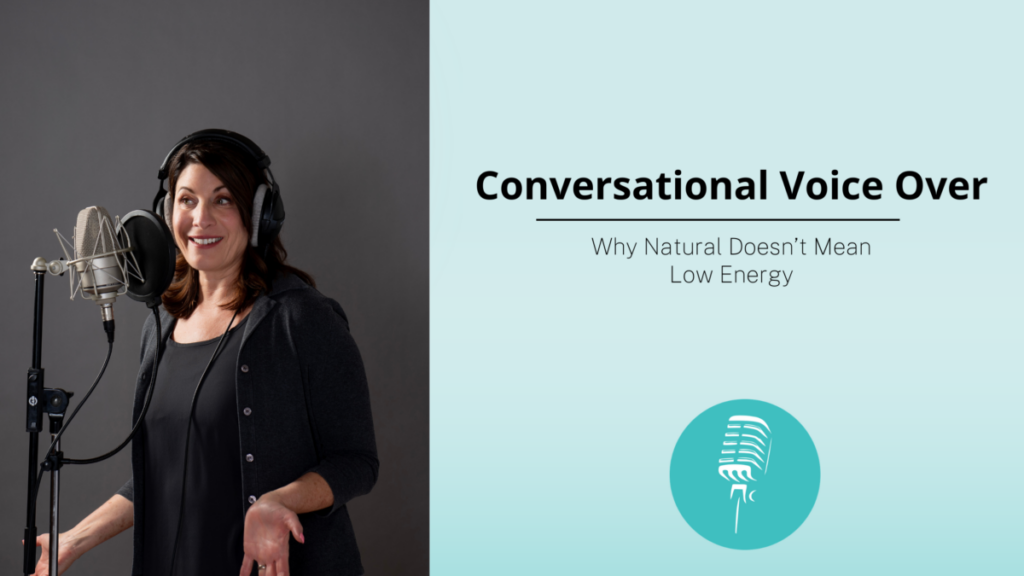
One of the most common directions voice actors hear is, “Make it sound conversational.”
On the surface, that sounds simple enough. Most people have conversations every day, so it seems like it should be easy to translate that into a voice over performance.
But this is where many beginner actors get stuck.
They hear the word “conversational” and assume it means they should pull everything back. The energy gets smaller. The emphasis disappears. The performance becomes more casual and restrained. In an effort to sound natural, the read starts losing the very thing that makes communication interesting.
The result is often a performance that sounds flat instead of conversational.
As an online voice over coach, this is one of the biggest misconceptions I hear in auditions. Actors are trying so hard not to sound performative that they accidentally remove the connection, intention, and engagement that make a read feel believable.
What Conversational Voice Over Actually Means
A strong conversational voice over read is not about sounding like you don’t care. It is more about connecting without sounding like you’re trying too hard.
Think about a real conversation with someone you care about. Even if you are speaking casually, you are still engaged in what you are saying. You have opinions. You react to information. Your thoughts evolve as the conversation unfolds.
You are not speaking in a perfectly even rhythm from beginning to end.
Your energy shifts.
Your emphasis changes.
Your focus moves from one idea to the next.
Those natural variations are what make conversations feel authentic.
The same principle applies to voice over.
A conversational voice over performance should feel like someone communicating a real thought to a real person. It should not feel like someone reading words off a page while trying to sound relaxed.
Why Flat Reads Often Miss the Mark
Many actors worry about sounding too “announcery” or overly performed, so they compensate by pulling the energy down too far.
While that may remove some of the artificiality, it often removes the personality as well.
The listener no longer hears a person with a point of view. They hear someone reciting information.
That distinction matters.
Most clients asking for a conversational voice over read are not asking for less engagement. They are asking for more authenticity. They want a performance that feels honest, relatable, and connected.
Those qualities come from intention, not losing all of your energy.
In fact, some of the strongest conversational reads still have a significant amount of energy behind them. The difference is that the energy is being driven by the thought rather than by the actor trying to sound exciting.
Real Conversation Is Full of Change
One of the easiest ways to improve a conversational voice over performance is to pay attention to how people actually speak.
Real conversations are dynamic.
We react when we hear something surprising.
We emphasize words that matter.
We become more excited about certain topics and more reflective about others.
We make discoveries as we talk.
That movement creates interest.
When every sentence in a script is delivered with the same pacing, emphasis, and emotional weight, the performance starts to feel predictable. Even if the voice sounds pleasant, the read lacks the contrast that keeps listeners engaged.
Strong voice actors allow those natural thought changes to influence their delivery.
It’s OK to “Just Talk”
A better approach is to ask yourself a few questions before recording.
Who am I talking to?
What do I want them to understand, feel, or do?
Why does this message matter?
Those questions create purpose behind the words.
And when a performance has purpose, it naturally becomes more conversational because it is rooted in genuine communication.
This is something I spend a lot of time helping actors develop as an online voice over coach. Once actors stop chasing a conversational sound and start focusing on conversational thinking, their reads become much more believable.
How to Make Your Reads Feel More Natural
Before your next audition, listen back and ask yourself a few questions:
- Am I connected to the message?
- Do I know who I am talking to?
- Does each line have a reason behind it?
- Are my thoughts evolving as the script moves forward?
If the answer to those questions is yes, you are probably much closer to a conversational voice over read than you realize.
The goal is to sound connected and like you’re pretty easy going.
When listeners hear genuine thought, intention, and engagement behind the words, the performance feels natural without becoming flat.
Want Help Creating More Conversational Reads?
If your auditions sound technically strong but still feel like they are missing something, an outside perspective can help identify what is getting in the way.
A free 15-minute discovery call is a great opportunity to talk about your goals, your current challenges, and where you would like to grow as a voice actor. We can discuss your auditions, your process, and whether coaching is the right next step for you.
Book your free 15-minute discovery call and let’s talk about creating more connected, believable voice over performances.